On the Work
On Water | On Trees | On Earth | Its Elemental
On Water
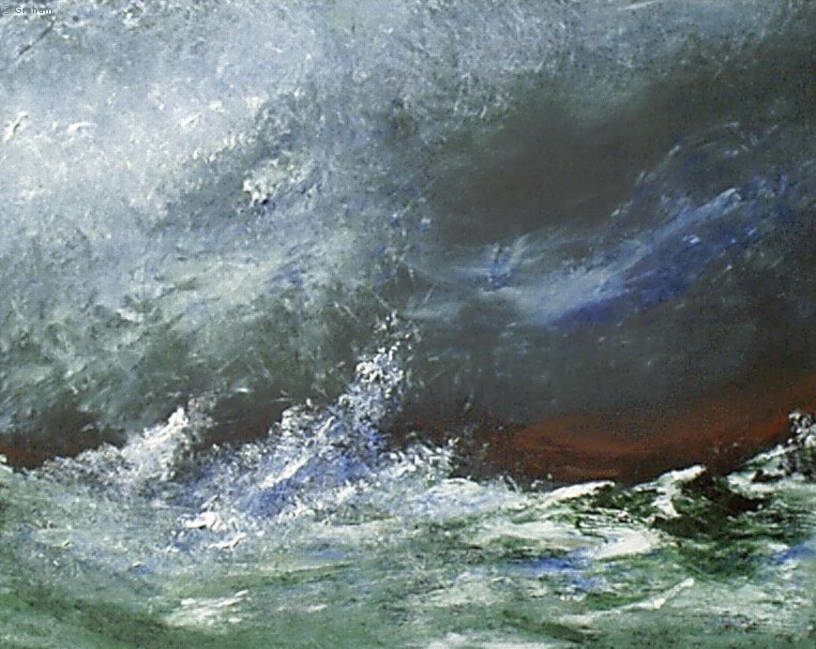
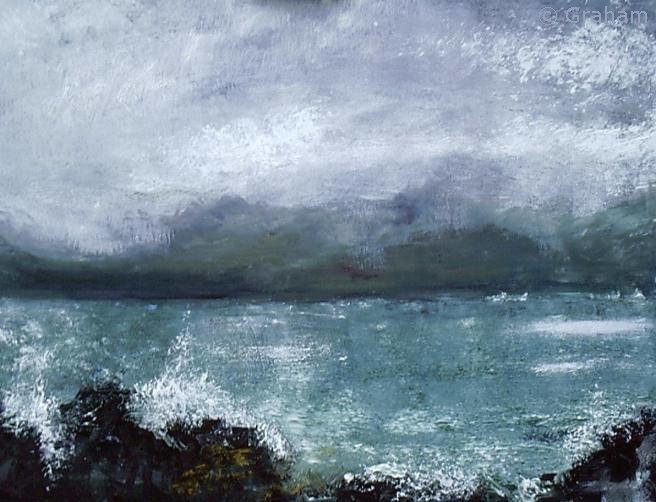
Heaven’s Rent is an expressionist seascape, typical of the Artist’s style. It depicts a storm at sea, with a dark, turbulent sea and dramatically rendered sky. The composition is dominated by saturated colours of blue, white and red and the vigorous impasto creates a sense of energy and movement.
In regard to her relationship with the sea, the Artist states:
If things are not right in my head, my heart or with my work, I go to the sea. It doesn’t give me perspective in the usual way of things – it rushes me through extremes from being utterly insignificant before it, to exhilaration at the sound and majesty of the spectacle of a storm. Most of all, it doesn’t ask anything of me; it doesn’t know I exist, much less care. It’s an element being elemental, nothing personal, making no choices or judgements, just doing what it does. Such freedom from conscious thought, I am moved between admiration and jealousy, but at least I am moved and the problem I arrived with is changed or gone.
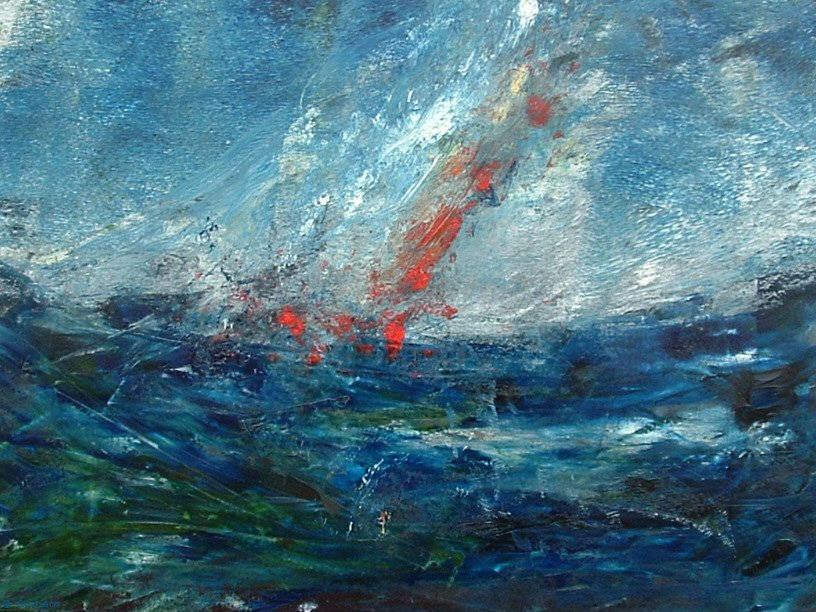
— From the catalogue of “Flow” joint travelling exhibition from the Office of Public Works, Ireland and the Department of Finance and Personnel, N. Ireland
On Trees
Walking the mountains and the coastal edges I come upon trees, individuals who have started life in a cleft in the rock of a bleak and windswept landscape. I salute these resolute survivors, their one-sided branches foreshortened by the prevailing winds, and carved, twisted trunks as hard as the rock that holds them.
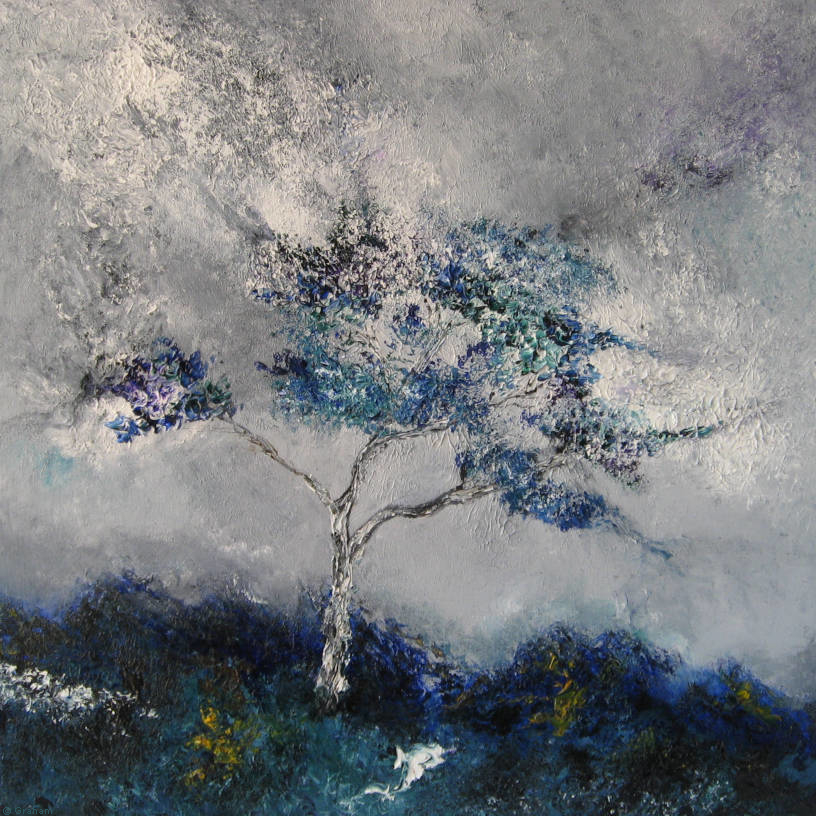
They are small, but venerable, older than many of the majestic trees of the parklands. They are shaped by circumstance, a bird perhaps dropped a seed in hostile territory, yet they are determined to grow, shaped by the elements, uncomplaining, and giving joy to the traveller who passes.
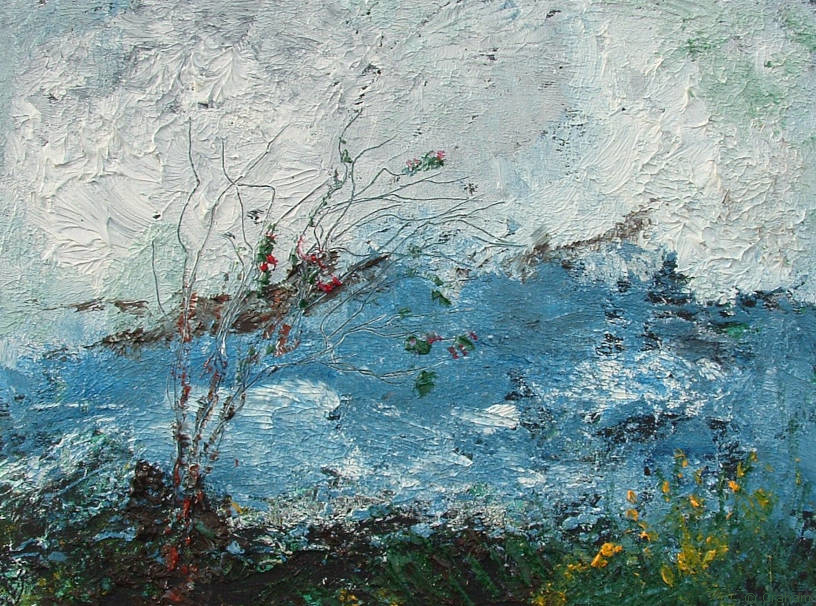
These trees are small, the fairy thorn that old lore says must remain untouched; the amazing fuchsias, standardised by grazing sheep to make an umbrella at perfect height for sheep to shelter; the lone mountain holly with bleached bone trunks as hard as stone, leaning to look out across the limitless horizon searching for another.
On Earth
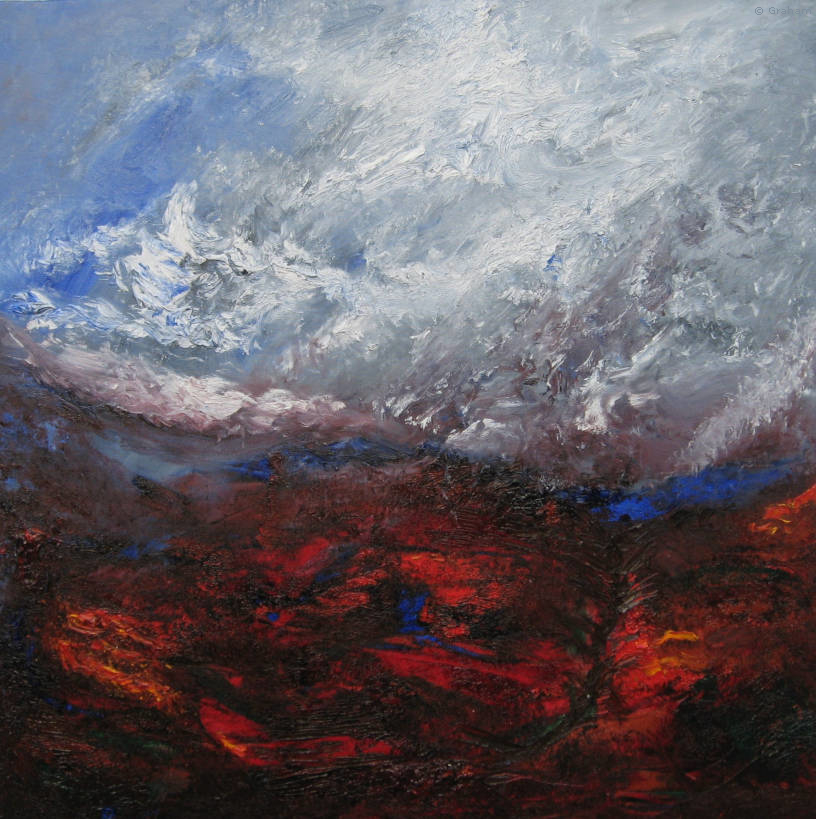
Her landscapes are intensely coloured, hills bright with fiery heathers, but smothered by heavy, grey skies – they are bleak but beautiful, lonely but comforting.
— FROM “THE ECHO”, JOANNE O’CONNOR 2006
It’s Elemental
The wind that whips across the Atlantic Ocean blows unhindered until it slashes into and bounces over the limestone walls of Kerry’s slanted shores. Linda Graham’s studio stands on a rolling ridge that looks over a few miles of sloping green Ireland to the Ocean of the World. St. Brendan’s home mountain looms in the distance, visible or not.
The art she makes there is as serious as a tough night in the emergency room. The paintings pulse with the rhythms of stippled waves and vascular blood. Linda Graham is the kindest fearsome person I have ever met – or the most fearsome kind person, probably the latter.
Her strict views from the edge of Ireland are exterior sights of interior feelings, all correlative to Kerry. The battering seas are indifferent to any small crux of a human who would cast themselves into that cold cauldron. But Linda has discovered a weird safety in an uncompromised respect for nature’s intermingled powers. This artist balances on the narrow fulcrum between the interior and the exterior, absorbing, then matching the outside world with internal strength and practiced technique. There is plenty of passion in the rendering, but there is also an ultimate calm in the comprehension of the whole.
The air in “Rock of Ages” is made palpable in settling mist and grey rain that sweeps across the canvas in textured paint, an effect that is just about lost when the painting is reduced to a photograph or a computer screen or a memory. Linda Graham’s work needs to be witnessed so closely that the warden should warn you off. Retreat to arm’s length, eventually back to the room’s reach, still focusing on the rippled bay, crowded sky, and the line of undulant hills between. Finally retrace your steps to the spot where you both see and feel the torque of sensation when paint turns into elements of air, elements of water, elements of earth — all fused by Gaelic fire.
Jackson Pollack layered and twirled his paint into abstract stations of feeling. Linda’s manipulation of paint partakes of the same process, yet is of a piece with place. What became abstract out of Pollack’s can of cheap paint takes recognizable shape from Linda’s careful palette. The form she finds in a seascape is indeed “out there,” but the thick atmospheres swag across the canvas with a power that only an interior correspondence could engender. She transmutes inert pigments into gales and freshets by twisting paint into elemental life, born out of her heart and carried to canvas by decisive fingers.
Linda Graham is big hearted and kind, but she is also crushingly self-critical and as merciless as a meaded-up Viking when it comes to keeping or binning a current piece. She brings all of her prodigious self to the canvas and achieves that Romantic aim of turning a fleeting moment into a sublime and eternal artifact, ready to unleash its elemental power the instant it is perceived by a receptive viewer.
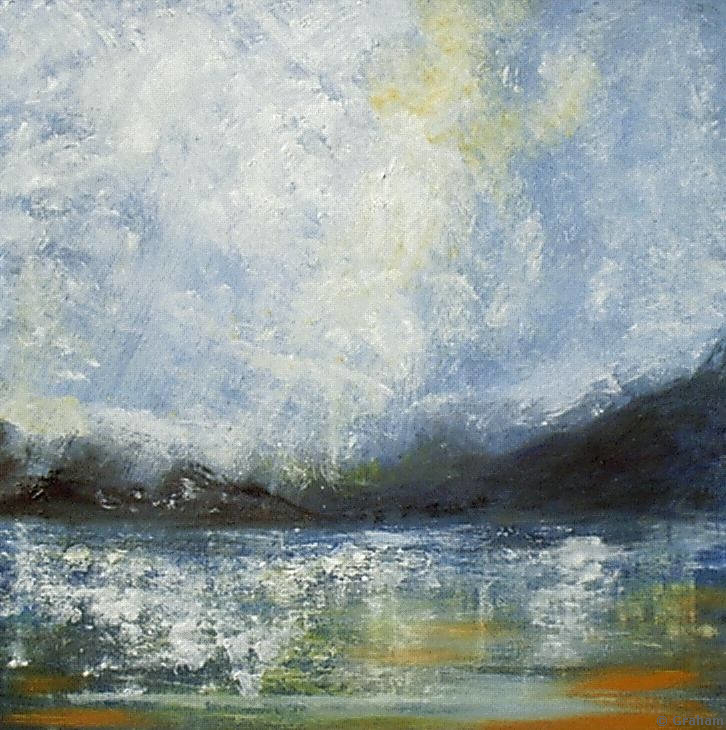
Linda’s reverence for Van Gogh is not unique, but it is remarkable. She ran away from home when she was fourteen to be near the Van Goghs in Amsterdam and found her way into a Dutch art school a couple of years later. Her practice, however, sets her apart, both from slavish imitators and the master himself. She has gone her own way. “Sun After Rain” has all the cosmic action of Van Gogh’s “Starry Night” without the hyperbole. Such a cloud-whirled sky is not an unfamiliar sight on the coast of Kerry and it loses nothing in its translation to canvas. Know that every curl of line, every roll of color, every layer of texture is ultimately intentional, however fiercely formed. The paroxysm of weather may look like it has been laid down in a fever of work — a fit of flow — but there is control and order suffused throughout. She strives against — and collaborates with — the powers that make us most alive and ultimately do us in.
This exhibition [Storm Force 10] awaits the final varnish that is applied by the public’s contemplation. Take your chances. Spend time with these paintings and breathe the bracing air of Ballinskelligs Bay, without having to brave the traffic jam at Moll’s Gap. All you need is a functional retina and the paintings will start working on you — like a gale off the Atlantic.
— James Bogan
James J. Bogan is Distinguished Professor of Art History and Film at the University of Missouri, U.S.A. He is one of the worlds leading authorities on William Blake and has several books and documentary films to his credit.